



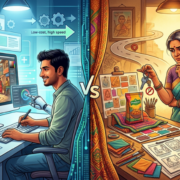


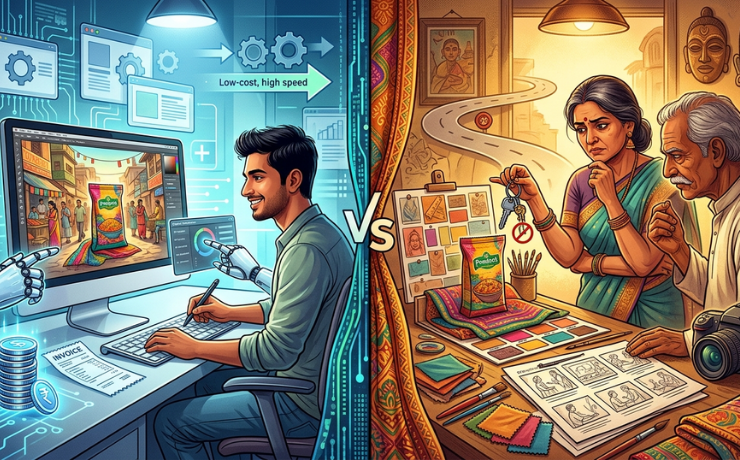
The Indian advertising industry has always romanticised the chaos of production. The overnight edits, the last-minute script rewrites, the director’s instinctive improvisation on set, the agency war room running on caffeine and impossible deadlines — this unpredictability was treated not as inefficiency, but as the texture of creativity itself. Generative AI is beginning to dismantle that mythology. Today, an ad film that once required a production house, visual effects team, location permissions, multiple shoots, and weeks of post-production can now be prototyped, visualised, and in some cases nearly executed through AI-powered workflows in a fraction of the time and cost. For agencies and brands facing relentless pressure on margins, timelines, and content volume, the proposition is irresistible. But beneath the excitement sits an increasingly uncomfortable industry question: if advertising becomes infinitely faster and cheaper to produce, what exactly happens to the craft that made it emotionally resonant in the first place? Indian advertising is entering a phase where efficiency is no longer merely supporting creativity. It is beginning to challenge it directly.
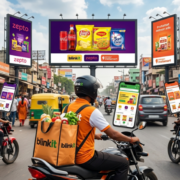
The attraction of generative AI in ad production is obvious, particularly in a market like India where brands are expected to create content at industrial scale across languages, platforms, audience cohorts, and commerce ecosystems simultaneously. Marketing teams today are no longer producing a handful of flagship campaigns annually. They are expected to feed an always-on digital machine demanding daily assets, regional adaptations, performance creatives, short-form videos, product explainers, influencer edits, and hyper-personalised content variations. Traditional production economics were simply not built for this velocity. Generative AI solves a real operational problem. Agencies are already using AI tools for storyboard visualisation, scripting assistance, voice cloning, synthetic dubbing, pre-visualisation, background generation, image extension, automated edits, and even AI-generated digital humans for low-cost content creation. Production houses that once took weeks to produce multiple edits can now generate iterations in hours. For smaller brands and startups, this is especially transformative because it dramatically lowers the barrier to professional-quality communication. A founder with a small marketing budget can suddenly access creative capabilities that previously required agency retainers and expensive production ecosystems. In many ways, generative AI is democratising production sophistication across the market. As one creative leader recently remarked, “AI is becoming advertising’s electricity — invisible when working well, but impossible to function without.” The metaphor is important because electricity did not replace industries; it rewired them. AI is beginning to do the same to advertising production.
Yet the anxiety within the industry is equally real, because advertising has never been valued merely for output volume. The best campaigns succeed because they capture nuance, timing, cultural tension, humour, aspiration, and emotional truth in ways audiences instinctively recognise as human. AI-generated advertising, despite rapid improvements, still struggles with that intangible layer of cultural instinct. Much of the current AI-assisted creative output across the industry carries a certain sameness — visually polished but emotionally hollow, technically impressive but creatively forgettable. This is particularly dangerous in India, where advertising effectiveness often depends on cultural specificity and emotional texture rather than visual perfection alone. Indian consumers respond to authenticity, social context, language rhythms, regional cues, and emotional contradictions that cannot always be reverse-engineered through prompts and datasets. The risk is not simply bad creative. The deeper risk is creative homogenisation. When every agency begins using similar AI models trained on the same global aesthetic patterns, advertising risks converging toward a generic visual language optimised for efficiency rather than originality. Already, some industry professionals privately admit they can identify AI-assisted work almost instantly because of its overly symmetrical compositions, polished artificiality, and lack of lived-in imperfection. Creativity has historically thrived on unpredictability. AI thrives on probability. That tension may define the next decade of creative work. Moreover, the production ecosystem itself is undergoing psychological disruption. Editors, illustrators, voice artists, junior designers, animators, and post-production specialists increasingly find themselves questioning where human value will sit in AI-accelerated workflows. The concern is not immediate replacement alone. It is gradual devaluation. When clients become accustomed to cheaper production cycles, the perceived economic value of craft begins to shift alongside it.
What makes this moment particularly significant for Indian advertising is that the debate is no longer theoretical. AI is already embedded inside real agency workflows, production pipelines, and client conversations. The question is not whether AI will be adopted further, but whether the industry can avoid reducing creativity into a pure efficiency equation. Historically, advertising has always evolved through technological shifts — from print to television, from television to digital, from digital to algorithmic performance media. But generative AI feels different because it touches the act of creation itself rather than merely the medium of distribution. It compresses ideation, production, execution, and iteration into one continuous machine-assisted process. That changes not only cost structures, but also the emotional rhythm of creative work. Agencies may eventually discover that the true competitive advantage is not access to AI tools — because those will become widely available — but the human judgment guiding them. The agencies that win will likely be those that use AI to remove friction without removing imagination. In that sense, the future of Indian ad production may not belong to purely AI-generated creativity or purely human craftsmanship, but to hybrid creative systems where technology handles scale while humans protect distinctiveness. “A machine can generate a thousand images,” as one producer put it recently, “but it still takes human instinct to know which one deserves to exist.” That may ultimately become the defining principle of the next creative era. Because in advertising, audiences rarely remember the most efficient campaign. They remember the one that made them feel something real.

Disclaimer: Information mentioned here has not been verified or endorsed by Agency Reporter and is in accordance with the press release shared by the company or their appointed representatives
