











How YouTube Creators Are Becoming Full-Blown Media Companies in India

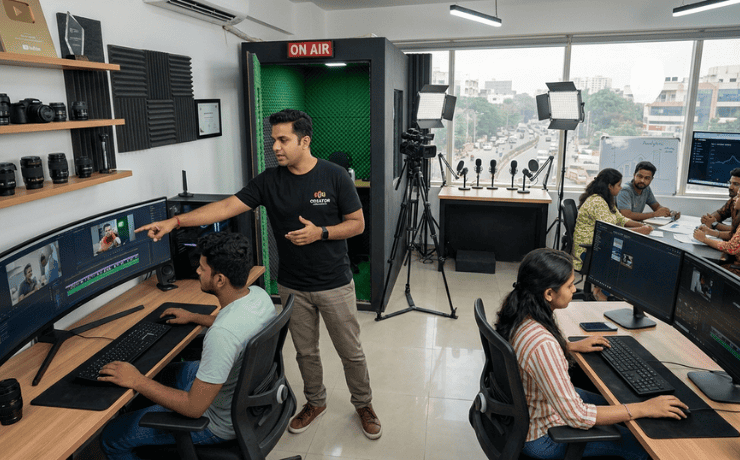
The old media playbook in India was simple. Build an audience slowly, scale distribution through television or print, attract advertisers, and then expand into events, IPs, licensing, and commerce. What is remarkable today is not that the model has changed, but that YouTube creators have compressed the entire cycle into a few years. Some of India’s most influential media businesses are no longer emerging from legacy networks or venture-backed publishers. They are being built from bedrooms, gaming setups, podcast studios, and creator collectives. The creator economy is no longer behaving like an extension of entertainment. It is beginning to resemble a parallel media industry with its own economics, talent systems, advertising structures, and intellectual property pipelines. And perhaps the clearest signal of this shift is that creators are no longer trying to become celebrities. They are trying to become companies.
The evidence is everywhere. What began as individual-led channels built around personality-driven content is rapidly evolving into multi-format content businesses with operational depth. Creators are hiring writers, producers, editors, strategists, researchers, business managers, and brand partnership teams. Many now operate with structures that look less like influencer setups and more like digital-era production houses. India’s largest YouTubers are launching podcasts, live events, merchandise lines, D2C brands, educational products, gaming communities, and subscription ecosystems around their audience bases. The economics also reflect this evolution. Advertising revenue from YouTube itself has become only one layer of monetisation. Brand partnerships, owned IP, licensing, affiliate commerce, live experiences, and platform diversification are increasingly where the real enterprise value sits. In many cases, the channel is simply the top of the funnel. The actual business exists beneath it. One industry executive recently described creators as “today’s media houses with tomorrow’s retail ambitions,” and the phrase captures the moment perfectly. These are not creators chasing virality anymore. They are audience-first businesses building recurring attention economies.
What makes this transformation particularly significant in India is the scale and behavioural shift of digital consumption. India’s internet audience is young, mobile-first, multilingual, and increasingly distrustful of overly polished institutional media. YouTube creators succeed because they feel accessible, culturally fluent, and algorithmically omnipresent. They occupy the same emotional space television anchors and film stars once controlled, but with far greater intimacy and frequency. A viewer may spend more cumulative time with a finance creator, gamer, comedian, or podcaster in a week than with any mainstream television network. That changes how influence works. Brands have noticed this before agencies fully recalibrated around it. Increasingly, advertisers are not buying creator integrations as tactical add-ons. They are structuring long-term partnerships, co-created IPs, and even product collaborations around creator ecosystems. The language has shifted from “influencer marketing” to “creator-led media strategy,” and the distinction matters. Influencer marketing was campaign-driven. Media companies are infrastructure-driven. The smartest creators understand this difference deeply. They are investing in consistency, production quality, audience analytics, retention mechanics, and community-building with the seriousness of legacy broadcasters. Some are even building internal sales teams rather than depending entirely on talent agencies. Others are operating like mini-streaming platforms with multiple vertical channels targeting different audience cohorts. The sophistication is becoming difficult to ignore. A decade ago, creators wanted brand deals because they needed monetisation. Today, brands need creators because they need relevance.
This is also forcing a larger rethink across the media and advertising ecosystem. Traditional broadcasters are discovering that attention fragmentation is not temporary. Agencies are grappling with the fact that creators can now deliver not only reach, but also cultural immediacy and measurable engagement at a speed institutional media often struggles to match. Even production economics are being rewritten. A creator with a lean team, a loyal audience, and platform-native storytelling instincts can sometimes outperform heavily funded content properties with far lower overheads. That efficiency is changing advertiser expectations around ROI, turnaround time, and audience targeting. But the bigger shift may be philosophical. Legacy media historically controlled distribution first and talent second. Creator-led media flips the equation entirely. The audience follows the individual, not the platform. “In the new media economy, distribution no longer owns attention; personality does,” as one observer aptly put it. This creates enormous power for creators, but also immense pressure. Running a media company demands operational discipline, brand safety awareness, legal understanding, team management, and the ability to evolve beyond personal charisma. Not every creator will survive that transition. Many channels built entirely on algorithmic momentum will plateau when novelty fades. But the creators who successfully institutionalise themselves — who build systems rather than depend solely on spontaneity — are likely to define the next decade of India’s media business. The real disruption, then, is not that creators are competing with traditional media. It is that they are becoming it, while rewriting the rules at the same time.
Disclaimer: Information mentioned here has not been verified or endorsed by Agency Reporter and is in accordance with the press release shared by the company or their appointed representatives
