













When AI Writes the Brief, the Creative & the Report — What’s Left for the Agency?

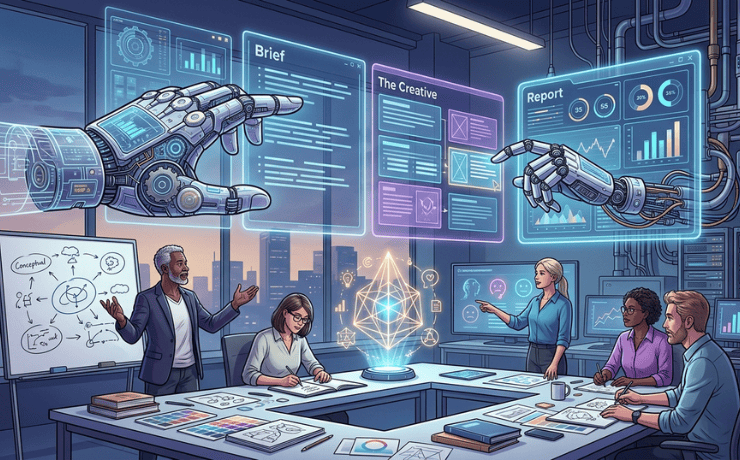
There is a strange silence slowly creeping into agency boardrooms — not because business has disappeared, but because machines have become unexpectedly good at doing the work that once defined the industry. A marketer enters a prompt into an AI platform and receives a campaign brief in seconds. Another generates social media copy before the morning coffee arrives. Presentation decks are automated, audience insights are summarised instantly, media plans are optimised in real time, and performance reports practically write themselves. The speed is astonishing. The convenience is undeniable. But somewhere beneath the excitement sits a more existential question that the advertising industry is only beginning to confront honestly: if artificial intelligence can write the brief, generate the creative, optimise the targeting, and produce the report, then what exactly remains the agency’s role? For decades, agencies positioned themselves as indispensable interpreters of culture, creativity, and consumer behaviour. Today, AI is rapidly entering each of those territories. The anxiety surrounding this shift is not entirely about job replacement — it is about identity replacement. The industry is discovering that automation does not merely threaten repetitive tasks; it challenges the very processes agencies once considered uniquely human. Yet the deeper irony is this: advertising has always sold imagination, but the business itself often relied heavily on systems, repetition, templates, and predictable workflows. AI has simply exposed how much of agency life was operational rather than truly inventive. As one creative leader recently remarked during a private industry discussion, “AI didn’t kill mediocre advertising. It revealed how much of the industry was already functioning mechanically.” That observation feels uncomfortable precisely because it carries truth.
The transformation is unfolding faster than most agencies expected. What initially appeared to be assistive technology has quickly evolved into something much more disruptive. Generative AI tools are now capable of producing campaign concepts, visual mockups, taglines, scripts, strategy summaries, customer personas, and performance analyses within minutes. Tasks that once demanded multiple departments and days of coordination can increasingly be executed by smaller teams with significantly lower costs. For clients already under pressure to justify marketing spends, the appeal is obvious. Why wait two weeks for a strategy deck when AI can produce a reasonably polished version overnight? Why spend heavily on adaptation work when automation tools can generate multiple creative formats instantly? This efficiency is reshaping client expectations in real time. Agencies are no longer competing only against rival networks; they are competing against speed itself. And speed, unlike creativity, has become measurable. Yet this technological acceleration is also creating an illusion that marketing can be reduced entirely to optimisation. AI can analyse patterns, predict performance trends, and mimic language styles with startling accuracy, but it still lacks the instinctive human understanding that often separates culturally resonant campaigns from forgettable content. Advertising does not exist in spreadsheets alone. It lives in emotion, timing, contradiction, social tension, aspiration, humour, insecurity, and human irrationality — areas where algorithms still struggle to fully comprehend nuance. A machine may know what audiences clicked on yesterday, but it cannot entirely explain why certain campaigns become part of culture while others disappear despite perfect optimisation. The danger for agencies is not AI replacing creativity altogether; it is the industry becoming so obsessed with efficiency that it forgets creativity was never meant to be efficient in the first place.
At the same time, AI is quietly exposing another uncomfortable reality about modern advertising: many clients were never truly paying agencies for originality alone. They were paying for speed, scale, execution, data management, reporting, and operational convenience. Once technology begins automating those layers, the traditional agency model naturally comes under pressure. This is why the current disruption feels far deeper than earlier digital transitions. When social media emerged, agencies adapted by building new verticals. When performance marketing rose, they hired specialists. But AI does not merely create another service line; it compresses multiple functions simultaneously. Junior copywriting, basic design adaptation, first-draft strategy thinking, reporting structures, consumer summaries, and even brainstorming support are all being reshaped at once. For younger professionals entering advertising, the implications are especially profound. The industry’s traditional learning ladder — where juniors sharpened their skills through repetitive tasks before developing strategic judgment — is rapidly disappearing. If AI handles the groundwork, agencies may eventually face a talent paradox: fewer entry-level opportunities today could result in fewer experienced creative and strategic leaders tomorrow. Yet amid the uncertainty lies an opportunity for reinvention. Agencies that survive this transition will likely be the ones that stop positioning themselves merely as execution partners and start operating more like cultural intelligence companies. In a world where everyone has access to the same AI tools, differentiation will no longer come from production capability alone. It will come from perspective. The agencies that matter will be those capable of interpreting human behaviour, understanding social context, identifying emotional truths, and guiding brands through increasingly fragmented cultural conversations. Technology may generate outputs, but meaning still requires interpretation.
Perhaps the future of agencies will depend less on competing with AI and more on understanding where human value becomes irreplaceable. Creativity has never been just about producing content; it has been about producing relevance. The most memorable campaigns in advertising history succeeded not because they were efficient, but because they captured something emotionally or culturally true about the moment people were living through. AI can imitate tone, structure, and even aesthetics, but authenticity remains more elusive. Human intuition still matters when navigating ambiguity, ethics, cultural sensitivity, humour, and emotional complexity — especially in markets as layered and unpredictable as India. The agencies that continue chasing volume alone may find themselves increasingly commoditised. But those that embrace AI as infrastructure rather than identity could emerge stronger, leaner, and more strategically valuable than before. In many ways, the industry now stands at a philosophical crossroads. Advertising was once built on the idea that creativity could not be systemised. AI is now testing that assumption daily. But perhaps the real question is not whether machines can create advertising. They already can. The more important question is whether brands still need humans to understand people. And the answer, at least for now, remains yes. Because while algorithms can process behaviour, they still cannot fully feel culture. And culture — messy, emotional, contradictory, deeply human culture — remains the one brief no machine can completely own.
