














Instagram Broadcast Channels vs WhatsApp Communities — Which Wins for Creator Monetisation?

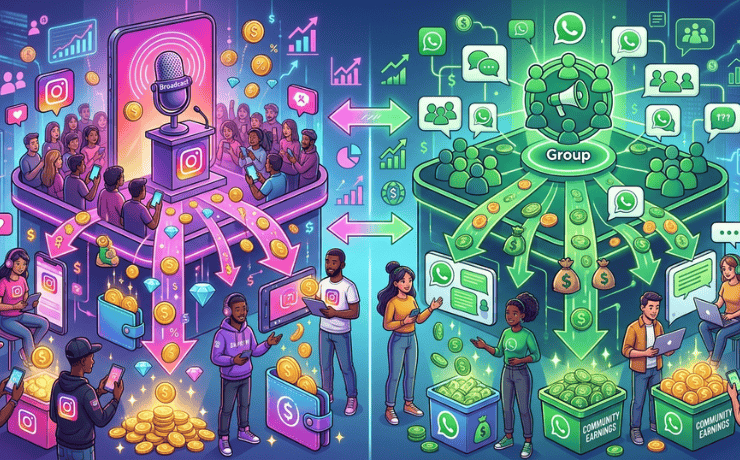
For years, social media platforms competed for creator attention through visibility. Now they are competing through ownership. The shift is subtle but significant. The modern creator economy is no longer only about reach, virality, or follower counts. It is increasingly about building closed ecosystems where audiences can be retained, nurtured, and monetised without depending entirely on unpredictable algorithms. That is precisely where the battle between Instagram Broadcast Channels and WhatsApp Communities becomes interesting. On the surface, both products appear to solve similar problems: direct communication at scale. But underneath, they represent two very different philosophies of creator monetisation. Instagram wants creators to deepen engagement while remaining inside the attention economy. WhatsApp, meanwhile, is positioning itself as infrastructure for high-intent communities that function almost like digital membership clubs. One platform thrives on discoverability. The other thrives on intimacy. One amplifies creators publicly. The other strengthens them privately. And as more creators in India move from influencer status toward becoming full-fledged media businesses, the question is becoming increasingly important: which ecosystem actually creates stronger long-term monetisation potential?
Instagram Broadcast Channels arrived at a time when creators were beginning to feel the fatigue of algorithm dependence. Organic reach volatility, declining feed engagement, and the relentless pressure to produce short-form content at scale pushed many creators to search for more stable audience relationships. Broadcast Channels offered a relatively elegant solution. Creators could speak directly to followers through text, voice notes, polls, and updates without fighting for visibility in the main feed. More importantly, it allowed creators to create a feeling of exclusivity while still operating within Instagram’s broader discovery ecosystem. A fashion creator could tease product drops, a finance educator could share market alerts, and a fitness influencer could distribute personalised routines directly to their audience. For brands, this opened an entirely new layer of creator partnerships that felt more conversational than performative. Sponsored content no longer had to exist only as polished Reels or Stories; it could now live inside a creator’s closer audience circle. But Instagram’s biggest advantage remains what it has always been: audience acquisition. The platform is fundamentally built for discovery. A creator can still go viral overnight, gain thousands of followers, and funnel those users into Broadcast Channels almost seamlessly. That top-of-funnel strength matters enormously in monetisation. Attention still feeds revenue. Yet the same system also creates fragility. Creators do not truly own audience access on Instagram. Platform dependency remains unavoidable. Algorithmic shifts, content saturation, and engagement fluctuations can still destabilise creator businesses quickly. Broadcast Channels may deepen relationships, but they still exist inside a platform optimised primarily for keeping users scrolling.
WhatsApp Communities operate from a very different behavioural dynamic altogether. Unlike Instagram, WhatsApp is not built around entertainment-first consumption. It is built around communication habits that already feel personal, trusted, and habitual. That distinction changes everything. When a creator enters a user’s WhatsApp environment, they enter a space psychologically closer to family groups, work updates, and personal conversations than public social media. The engagement quality becomes fundamentally different. Open rates are dramatically higher. Message visibility is stronger. Community participation often feels more intentional. In India especially, where WhatsApp penetration cuts across geography, language, and income groups, the platform offers creators something Instagram struggles to guarantee consistently: dependable reach. This is why an increasing number of educators, stock market creators, wellness coaches, regional influencers, and niche knowledge creators are building monetisation models around WhatsApp Communities. Paid groups, subscription access, exclusive workshops, private commerce drops, and premium advisory communities are becoming more common. The monetisation may not always look glamorous from the outside, but it is often more stable underneath. “Public platforms build fame; private platforms build businesses,” as one creator strategist recently observed. That line captures WhatsApp’s growing role perfectly. The platform may lack Instagram’s cultural energy and virality mechanics, but it compensates through trust and retention. Creators are discovering that smaller, highly engaged communities can often generate more meaningful revenue than massive passive audiences. In many ways, WhatsApp resembles the shift from mass advertising to CRM-driven relationship marketing. The audience may be smaller, but the intent is far stronger.
Still, declaring a clear winner between Instagram Broadcast Channels and WhatsApp Communities oversimplifies what is actually happening in the creator economy. The reality is that both platforms are beginning to serve different stages of the monetisation funnel rather than directly replacing one another. Instagram remains unmatched as a discovery engine. It is where creators build visibility, shape cultural relevance, and attract new audiences at scale. WhatsApp, on the other hand, is increasingly becoming the retention and monetisation layer where loyal followers are converted into paying communities. Smart creators are already using both strategically. They acquire attention on Instagram and deepen monetisation through WhatsApp. That dual-platform behaviour reflects a broader shift happening across digital media right now: creators are moving away from relying on single-platform ecosystems. Diversification has become survival. Algorithms can change overnight. Platform priorities can shift abruptly. Monetisable audience ownership therefore becomes the creator economy’s most valuable currency. Looking ahead, the platforms themselves understand this battle is about far more than messaging features. It is about who becomes the operating system for creator businesses. Instagram is betting on keeping creators inside the social graph. WhatsApp is betting on becoming the infrastructure for direct audience relationships. In India, where creator commerce, regional content, and community-driven monetisation are scaling rapidly, that competition will intensify significantly over the next few years. But perhaps the most interesting takeaway is this: the future of creator monetisation may no longer belong to the loudest platforms. It may belong to the platforms that make audiences feel closest to the creator. Because in the attention economy, visibility attracts followers. Intimacy builds revenue.
