











Social Media Credibility: Why Engagement Tricks Are Losing Their Power

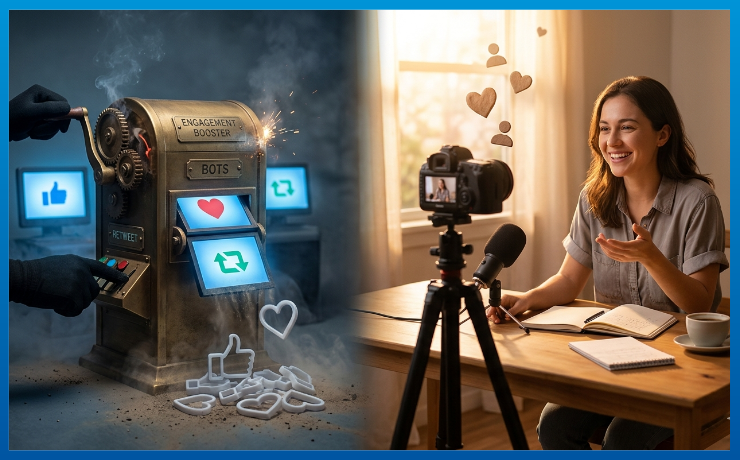
Spend a few minutes scrolling through LinkedIn today and a familiar pattern begins to emerge. A poll asking an obvious question. A caption nudging readers to “comment your thoughts.” Dozens, sometimes hundreds, of responses appearing within hours. On the surface, it looks like vibrant professional conversation. But for many users, the reaction is no longer curiosity. It is skepticism. The question that quietly lingers in the background is simple: Is this genuine engagement, or just another visibility tactic?
For years, social media marketing has operated on a straightforward assumption that engagement equals influence. The logic made sense in the early days of digital platforms. If people were interacting with content, it meant they cared about it. As a result, brands, creators, and agencies built strategies around maximizing those signals. Polls, reaction-driven posts, and comment prompts became reliable tools for boosting visibility in the algorithmic race for attention. Yet something has changed in the way audiences interpret these signals. What once felt interactive now often feels engineered. And when engagement begins to feel engineered, credibility quietly begins to slip away. In the world of social media, visibility can be manufactured, but belief cannot.
This shift is not the result of a single trend but of accumulated experience. Over the past decade, audiences have watched the mechanics of social media marketing unfold in real time. They have seen influencers endorse multiple brands within the same week. They have seen engagement pods artificially inflate comment sections. They have seen posts framed as conversations that are, in reality, carefully constructed prompts designed to trigger predictable responses. None of these practices are particularly new, but awareness of them has grown significantly. Today’s audiences are far more digitally literate than the marketers who once assumed they could easily outmaneuver the algorithm.
LinkedIn polls offer a useful example of this broader transformation. At their best, polls can provide quick insights into industry thinking or spark valuable debate. At their worst, they become a formula: ask a broad question, provide safe answer options, encourage comments, and watch the engagement climb. The tactic works from a numbers perspective, but numbers alone no longer tell the full story. When people feel that a conversation exists primarily to boost reach rather than explore ideas, participation begins to lose meaning. The post may still perform well on the dashboard, but the trust behind those interactions becomes thinner with each repetition.
What is emerging in place of these tactics is not necessarily a rejection of marketing, but a shift in what audiences value from it. Authenticity, a word that once sounded like a vague branding aspiration, is now becoming a measurable expectation. People are increasingly drawn to voices that feel grounded in real experience rather than strategic performance. A thoughtful reflection on a business challenge often resonates more than a perfectly optimized engagement post. A story about failure can spark deeper discussion than a polished announcement. Even simple, honest observations about industry trends can feel refreshing in a feed crowded with carefully packaged authority.
In many ways, audiences are rediscovering the difference between content that speaks and content that performs. The first invites conversation because it reflects genuine perspective. The second invites reactions because it is designed to trigger them. Both can generate interaction, but only one builds long term credibility. As one communications strategist once remarked during a panel discussion, “Attention is easy to capture online. Trust is what takes time.” That distinction is becoming increasingly important for brands and professionals trying to build influence on social platforms.
For agencies and marketers, this moment represents a subtle but important turning point. The tactics that once drove engagement at scale are beginning to deliver diminishing returns when it comes to perception. Audiences are no longer impressed by numbers alone. They are asking more instinctive questions: Does this person actually believe what they are saying? Is this insight coming from experience or from strategy? Is this conversation real or simply structured for visibility?
Answering those questions requires a different approach to digital communication. Instead of asking how a post might perform, marketers may need to ask whether it actually contributes something meaningful to the conversation. Thought leadership, in this sense, becomes less about appearing authoritative and more about sharing genuine perspective. Influencer partnerships work best when they feel natural rather than transactional. Brand voices resonate when they sound like people rather than campaigns. None of these principles are revolutionary, but they require a level of restraint that modern social media strategies do not always prioritize.
The irony is that social media, a space built on connection, sometimes drifted into a cycle of performance where metrics overshadowed meaning. Yet the current shift suggests that audiences are ready for something different. They are not abandoning platforms or conversations. Instead, they are gravitating toward voices that feel believable. The posts that linger in memory are rarely the ones that generated the most reactions. They are the ones that made readers pause, reflect, or recognize a piece of their own experience.
Perhaps that is the quiet lesson the industry is beginning to relearn. Algorithms may decide what people see, but credibility decides what they remember. And in a landscape overflowing with content designed to capture attention, the voices that stand out will not necessarily be the loudest ones. They will be the ones that sound unmistakably real.