














The New Media: YouTube Reporters and Newsletter Writers Are the PR Targets India Is Still Ignoring

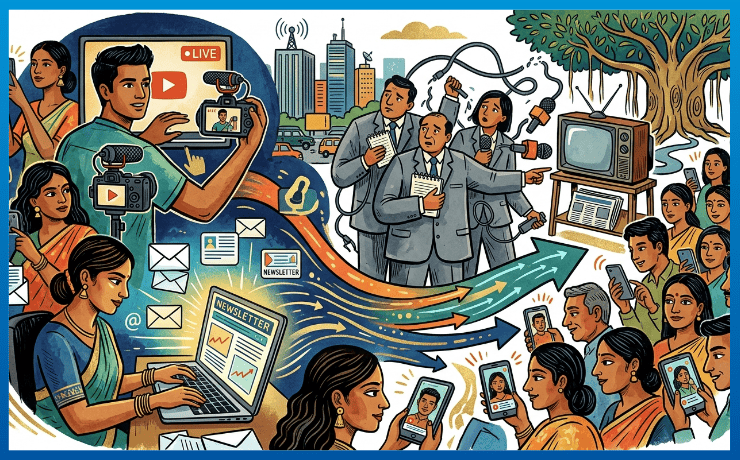
The media landscape did not change overnight. It changed one subscriber at a time, one open rate at a time, until one day the audience was somewhere entirely different and the PR industry was still knocking on the same old doors.
Picture this. A technology journalist with fourteen years of experience at one of India’s most respected English dailies quietly puts in her papers. No dramatic exit. No farewell column. She starts a Substack. Within eight months, she has forty thousand subscribers who pay a monthly fee specifically to read her analysis. Her open rates hover around fifty-two percent. For context, the print publication she left behind is fighting for single-digit readership growth. Across town, a former television anchor who spent a decade on primetime news is now running a YouTube channel focused on business and policy. His last three videos crossed two million views each. His comment section reads like a town hall. His audience does not just watch him. They trust him.
This is not an isolated story. Across India, a quiet but consequential migration is underway. Experienced, credible, deeply networked journalists are stepping away from legacy institutions and building their own platforms. They are writing newsletters that reach decision-makers, founders, policymakers, and consumers who have actively chosen to pay for or subscribe to their perspective. They are producing YouTube content that drives genuine conversation, not just passive consumption. And the Indian PR industry, for the most part, is still treating them as secondary targets, nice-to-haves, interesting experiments. That gap between where the audience has gone and where PR is still pitching is not just a missed opportunity. It is a strategic blind spot that is quietly making a lot of earned media campaigns less effective than they should be.
“The press does not own the press anymore. The journalist does.” — Anonymous, but felt by every communications professional who has watched a reporter’s personal following outlast the publication that once employed them.
The reason PR has been slow to adapt is understandable, even if it is no longer defensible. Traditional media relations was built on a logic of institutional gatekeeping. You pitched the Hindu. You pitched the Economic Times. You pitched NDTV. The institution validated the story, the journalist wrote it, and the audience received it. Accountability ran through the masthead. Relationships were with publications first and journalists second. That model worked beautifully for decades and created an entire profession built around knowing which editor wanted what kind of story, which desk was receptive to which angle, and which publication carried the most weight with which audience. The problem is that the gatekeeper model has been quietly dismantled from the inside. When a journalist leaves a publication and takes two hundred thousand Twitter followers, a newsletter list of sixty thousand, and a YouTube channel with a loyal niche audience with them, the institution does not retain that relationship capital. The journalist does. Which means PR’s old logic of pitching the publication first is increasingly pitching at an address where the most influential people no longer live.
India’s independent media ecosystem has matured faster than most PR professionals have given it credit for. The newsletter space alone tells a compelling story. Writers covering everything from Indian startup funding to foreign policy to regional politics to personal finance have built subscriber bases that rival the digital readership of many established publications, with one critical difference: their readers chose them deliberately. A subscriber to a paid newsletter about Indian venture capital did not stumble onto that content through an algorithm. They sought it out, evaluated it, and decided it was worth paying for. That is an audience with a level of intent and engagement that most traditional media properties can no longer guarantee. On YouTube, the picture is equally significant. Channels run by former CNBC journalists, ex-print reporters, and independent policy analysts are generating millions of views on content that would have once lived behind a newspaper paywall or in a ten-minute television segment. Their comment sections, community posts, and member interactions are creating a depth of audience relationship that broadcast media simply cannot replicate. For a PR professional trying to place a story that actually moves the needle with the right people, this is not a niche. This is where the conversation is happening.
The shift in approach that Indian PR needs to make is both practical and philosophical. On the practical side, it starts with building a database of independent creators that goes beyond follower counts. The metric that matters for a newsletter writer is not the size of the list but the open rate, the subscriber profile, and the quality of engagement. A newsletter with twenty thousand subscribers and a forty-five percent open rate reaching founders and senior marketers is a more valuable placement for a B2B brand than a feature in a publication with a million monthly visitors and a three-minute average session duration. For YouTube, the question is not how many views a channel gets on average but whether the audience of that channel maps to the client’s actual target demographic. A channel with three hundred thousand subscribers who are primarily first-generation investors in tier-two cities is a transformative platform for a fintech brand and entirely irrelevant for a luxury automotive client. The database needs to reflect that nuance. On the philosophical side, PR needs to let go of the idea that independent creators are easier to manage than institutional journalists because they have no editor above them. In reality, they are harder. They have no obligation to cover anything. Their audience relationship is their most valuable asset and they protect it fiercely. A newsletter writer who feels a pitch is lazy, irrelevant, or disrespectful of her audience’s intelligence will not just ignore it. She may write about why she ignored it. The bar for pitching independent creators is not lower than pitching traditional media. It is higher, because the relationship has to be built person to person, idea to idea, with no institutional framework to fall back on.
The Indian PR industry has always prided itself on adaptability. It navigated the arrival of cable television, the explosion of digital news, the rise of social media, and the chaos of the pandemic-era media environment. The emergence of independent journalism is not a disruption of a different order. It is the same story playing out again: the audience moves, the platforms evolve, and the profession has to decide whether it will lead the change or lag behind it. The agencies and communications professionals who are already building genuine relationships with India’s newsletter writers and YouTube journalists are not being progressive for the sake of it. They are being strategic. They understand that earned media in 2025 is not about where you place the story. It is about who tells it, who trusts the teller, and whether that trust extends to the brand being discussed. The masthead has not disappeared. But it is no longer the only address worth having in your media list. The inbox and the upload button are just as powerful now, and in some cases, they are more powerful than anything a traditional front page can offer.
India’s new media is not coming. It is already here, already influential, and already shaping how millions of informed Indians understand the world around them. The only real question left for the PR industry is a simple one: are you in their inbox yet?
