














How Live Commerce Works — and Why India Is Only Just Getting StartedHow Live Commerce Works in India

By Agency Reporter Editorial Desk | Creator Economy & Influencer Marketing | 6 min read
The number that keeps coming up in conversations about live commerce is this: in 2023, Li Jiaqi — a single lipstick-selling livestreamer in China — moved ₹14,000 crore worth of product in a single day. One person. One stream. One day.
That number is so large it sounds made up. But it is not. And it is the reason why every brand, every creator platform, and every adtech company with any interest in commerce is trying to figure out whether the Indian market can produce anything close to it.
The honest answer is: not yet. But the infrastructure is being built, the consumer behaviour is shifting in the right direction, and the brands and creators that understand the mechanics now will be significantly better positioned when live commerce in India crosses its own inflection point.
What live commerce actually is
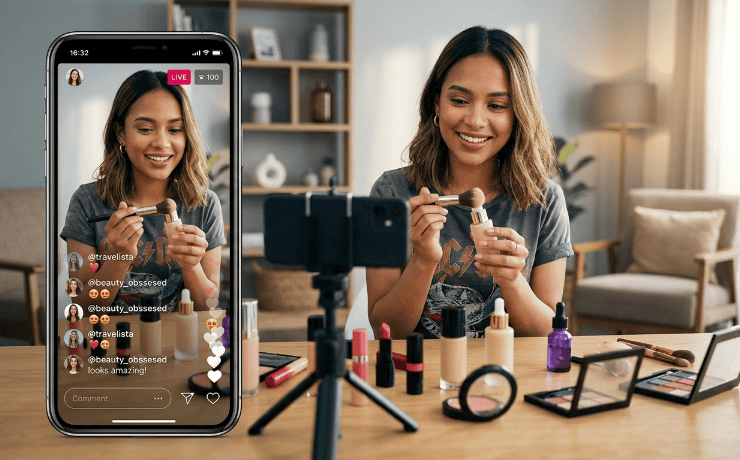
Live commerce is exactly what it sounds like — selling products through a live video stream. A creator or brand representative goes live on a platform, demonstrates and talks about products in real time, responds to questions from viewers in the comments, and provides a way to purchase immediately without leaving the stream.
The key word is “immediately.” The thing that makes live commerce different from influencer marketing, from YouTube reviews, from Instagram posts with shopping tags — is the collapse of time between seeing something and being able to buy it. A viewer watching a creator demonstrate a kitchen appliance at 8pm can have it ordered before the stream ends at 8:30. The consideration window, which traditional advertising tries to shorten, essentially disappears.
China’s Benchmark
Live commerce accounts for over 15% of China’s entire e-commerce revenue. Top streamers have managed $1.7 billion in a single 24-hour session. The market is dominated by Taobao Live, Douyin, and Kuaishou. Brands treat it as their primary product launch channel.
India’s Reality Today
Live commerce in India is early and fragmented. Instagram Live, YouTube Live, Meesho, and Flipkart’s live features are all used. No dominant platform has emerged. Creator monetisation infrastructure is thin. But watch time on live streams is growing sharply.
Why India’s version will look different from China’s
The China live commerce model was built on specific infrastructure that does not exist in India in the same form. Alipay and WeChat Pay created frictionless in-stream payment. Taobao’s integration of content and commerce was structural, not bolted on. And Chinese consumer culture had a particular relationship with group-buying and flash sale behaviour that made the urgency mechanics of live commerce feel familiar rather than pushy.
India’s version will be shaped by different infrastructure. UPI is arguably better payment infrastructure than anything China built — it is interoperable, it is widely adopted, it works across income levels. WhatsApp and Instagram are where Indian consumers actually spend their attention. And India’s creator economy has regional and linguistic diversity that creates opportunities for live commerce in ways the Chinese market never had — a Tamil beauty creator going live for Tamil-speaking audiences in Chennai and Singapore simultaneously, for example.
Where brands should be looking now
The brands getting live commerce right in India right now are mostly D2C companies — fashion labels, beauty brands, food and beverage companies that have built direct relationships with creators and are treating live sessions as events rather than campaigns. They plan for them like product launches: exclusive drops, limited-time pricing, creator briefings, real-time response teams for the comment section.
The brands that are not getting it right are the ones approaching live commerce with a traditional influencer marketing mindset — brief the creator, approve the content, measure the reach, move on. Live commerce requires operational involvement that most brand teams are not built for. You need inventory management, real-time pricing authority, customer service capacity for the comment section, and logistics that can handle a spike in orders in the first thirty minutes.
The creator angle — what is in it for them
For creators, live commerce represents a genuinely different revenue model from traditional sponsored content. Instead of a flat fee for a post, a creator can earn commissions on every sale made during a stream. The incentive alignment — creator earns more when viewers buy more — changes the nature of the content. It also changes which creators excel. The skills required for live commerce are different from those needed for a perfectly lit Instagram reel.
The creators who are building live commerce audiences in India tend to be highly conversational, deeply knowledgeable about their category, and comfortable with the unpredictability of a live format. They cannot script their way through a two-hour stream. This is creating a new tier of creator that is not the same as the influencer tier we have talked about for the last decade.
What to do if you are a brand manager reading this
Start by watching, not by spending. Spend two weeks finding the live commerce creators in your category — beauty, electronics, fashion, food — and watching their streams. Note what they demo, how they handle questions, what seems to drive purchasing decisions, which parts of the stream cause people to buy immediately versus browse later.
Then find one creator in your category whose audience overlaps with your target customer and propose a pilot. Not a traditional sponsored deal — a revenue-share arrangement where both parties benefit from strong conversion. Run it, measure it honestly, and then decide whether to scale.
Live commerce in India will not look like China’s version. It will look like something that emerged from India’s own digital culture, creator economy, and consumer behaviour. The brands that figure out what that version looks like — by doing, not by watching — will have built something genuinely difficult to replicate.
