














Micro vs Macro Influencers: The Data on Which Actually Drives ROI for Indian Brands

By Agency Reporter Editorial Desk | Creator Economy & Influencer Marketing | 6 min read
There is a running joke among influencer marketing managers in India. Every brand brief that comes in now says the same thing: “We want micro-influencers. Authentic ones. With high engagement.” And every agency nods along, puts together a roster of creators with 20,000 to 80,000 followers, and bills the brand accordingly.
Nobody stops to ask whether micro is actually right for what this particular brand is trying to do.
The micro-influencer consensus has become so strong in Indian marketing circles that it is functioning almost like received wisdom — something you repeat because everyone else is saying it, not because you have interrogated whether it applies to your situation. So let us interrogate it.
What the numbers actually say
India’s influencer marketing industry is projected to reach ₹3,375 crore by 2026, growing at 18% annually. That is real money and real growth. Within that, the shift toward smaller creators is genuine and documented.
Nykaa moved a significant portion of its influencer budget from celebrity endorsements to partnerships with over 200 beauty micro-influencers — creators with between 10,000 and 50,000 followers who genuinely use and review skincare products. The results were measurable enough that it became an industry case study.
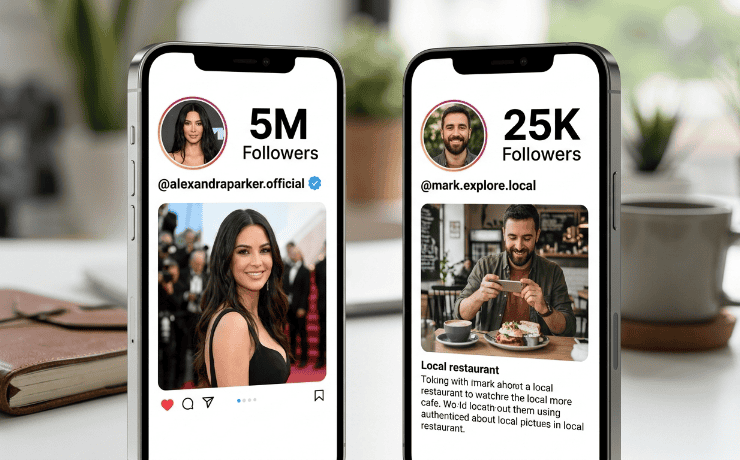
The engagement data consistently favours smaller creators. Nano and micro influencers routinely achieve engagement rates of 4–8% on Instagram. Macro influencers — those with 500,000 to a million followers — typically see 1–3%. Mega influencers and celebrities often drop below 1%.
| Tier | Follower Range | Avg. Engagement | Cost Per Post (est.) | Best Used For |
|---|---|---|---|---|
| Nano | 1K – 10K | 6–10% | ₹2,000 – ₹15,000 | Hyper-local, community trust |
| Micro | 10K – 100K | 4–8% | ₹15,000 – ₹1,20,000 | Niche authority, conversion |
| Macro | 100K – 1M | 1–3% | ₹1,20,000 – ₹8,00,000 | Reach, brand visibility |
| Mega / Celebrity | 1M+ | 0.5–1.5% | ₹8,00,000+ | Mass awareness, PR impact |
The problem with just comparing engagement rates
Here is where the conversation usually goes wrong. Brands see the engagement rate data, conclude that micro beats macro, and make their decision. But engagement rate is a proxy metric. It tells you how many people bothered to double-tap or leave a comment. It does not directly tell you how many people saw the post and bought something, told a friend, or searched for the brand afterwards.
A celebrity with a 0.8% engagement rate on a post seen by 3 million people still generated 24,000 direct interactions. A micro-influencer with a 6% engagement rate on a post seen by 25,000 people generated 1,500. The celebrity’s absolute number is 16 times higher.
This is not an argument for celebrities over micro-influencers. It is an argument for thinking clearly about what you are trying to achieve before you pick a tier.
When micro actually wins
Micro and nano influencers genuinely outperform larger creators in specific situations, and it is worth being precise about what those situations are.
When the product requires trust, micro wins. Skincare, supplements, financial products, baby products — categories where a viewer needs to believe the person actually uses what they are recommending. A 25,000-follower beauty creator who has been posting honest skincare reviews for three years carries more credibility in that niche than a Bollywood celebrity who signed a one-campaign deal.
When the goal is conversion rather than awareness, micro wins. The closer someone is to the audience they are trying to reach — geographically, demographically, in terms of shared interests — the more likely a recommendation translates into action. A fitness micro-influencer in Pune talking to other Pune runners about a protein brand is an extraordinarily efficient conversion engine.
When budget is the constraint, micro wins almost by default. You can run a campaign with 50 micro-influencers for the cost of one macro creator. The diversity of voices, geographies, and audience segments you get from that spread can outperform a single large post even on pure reach metrics.
When Macro Still Makes Sense
- Mass product launches needing fast reach
- Brand repositioning — changing perception at scale
- Categories where aspiration matters more than trust
- Festive season campaigns with short windows
- When PR value and press pickup matter
When Micro Wins
- Trust-led categories — health, finance, parenting
- Conversion-focused campaigns with trackable links
- Regional or Tier 2/3 audience targeting
- Long-term ambassador programmes
- D2C brands building communities, not just sales
The regional creator opportunity that most brands are still sleeping on
One of the most underutilised areas of micro-influencer marketing in India is regional language creators. Influencers producing content in Tamil, Telugu, Marathi, Bengali, and Kannada are seeing engagement rates that put their Hindi-language counterparts to shame. Their audiences in Tier 2 and Tier 3 cities are less saturated with sponsored content and more responsive to brand messages.
Yet most influencer briefs still specify “Instagram, Hindi preferred.” That preference is costing brands reach and efficiency in markets that are growing faster than the metros.
What good measurement looks like
If you are going to invest seriously in influencer marketing, you need better metrics than engagement rate and follower count. The brands getting real value from influencer campaigns are tracking click-through rates on unique links, promo code redemptions, website traffic spikes correlated with post timing, and — for longer campaigns — repeat purchase rates among audiences acquired through influencer channels.
These are not complicated to set up. They require UTM parameters, unique discount codes per creator, and someone on the team who is willing to look at the data honestly rather than just pulling the engagement screenshots for the post-campaign deck.
India’s influencer marketing industry is growing fast enough that the brands who figure out measurement now will have a significant edge over those still debating follower counts in two years. The question was never micro vs macro. It was always: does this creator genuinely connect with the people I am trying to reach, and can I prove it?
