














Five Indian D2C brands that built themselves entirely on influencer marketing

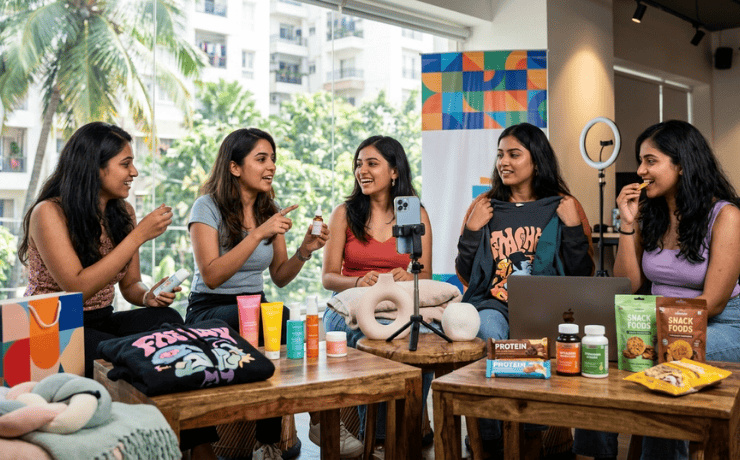
There was a time when launching a consumer brand in India meant playing the long game—raising capital, buying media, pushing for shelf space, and waiting for recall to build. That path still exists, but a different one has emerged alongside it. A number of D2C brands have grown without following that script too closely. Instead of starting with large campaigns, they began by showing up in conversations people were already having—on Instagram, YouTube, and a growing list of creator-led platforms. Influencers weren’t brought in later to amplify awareness; they were there from the beginning, shaping how these brands were seen and understood. It’s a subtle shift, but an important one. In these cases, marketing didn’t feel like something added on—it was woven into how the brand took shape.
Consider Mamaearth. In its early phase, it didn’t try to compete with established beauty and personal care players through heavy advertising. Instead, it appeared in content created by parenting bloggers and young mothers who were already talking about product safety, ingredients, and everyday choices for their families. The brand’s messaging fit naturally into those conversations. People didn’t encounter it as a polished campaign; they came across it through recommendations, reviews, and shared experiences. That repeated exposure, across many small creators rather than a few big ones, helped build familiarity over time. By the time Mamaearth expanded its presence beyond digital, it wasn’t entirely new to its audience. It had already been part of their feed, often more than once.
Sugar Cosmetics followed a different route, but relied on a similar foundation. The brand had a strong point of view from the start and didn’t attempt to dilute it for broader appeal. It worked closely with beauty creators who reflected that same tone—confident, direct, and a little unconventional. Instead of polished advertisements, most of the early visibility came through tutorials, reviews, and everyday content where the product simply became part of the routine. What stood out was the consistency. The brand voice didn’t change from one creator to another, even though the formats did. Over time, this made Sugar feel recognisable, even in a crowded category. It wasn’t just about the product; it was about the personality that came through repeatedly.
With boAt, the scale looked different. The brand didn’t rely on a handful of faces. It spread itself across a wide mix of creators—fitness enthusiasts, gamers, musicians, and lifestyle vloggers. Its products were easy to feature in daily scenarios, which made them show up in a range of content without feeling out of place. You might notice the same pair of earphones in a workout clip, a travel video, or a desk setup, all from different creators. Individually, these moments were small. Collectively, they added up. The brand became visible not through one big push, but through constant presence. It’s the kind of visibility that builds quietly, without drawing too much attention to itself.
WOW Skin Science leaned more towards explanation than repetition. Many of its products needed a bit of context—what they contained, how they worked, why they were different. Influencers became a way to break that down in a format people were willing to spend time on. Instead of short claims, there were longer reviews, demonstrations, and comparisons. This approach suited an audience that was becoming more curious about ingredients but didn’t always know how to interpret them. The brand didn’t try to simplify everything into a single message. It allowed space for creators to explain, which helped build a different kind of credibility—one that came from understanding rather than just recall.
The Man Company entered a category that was still finding its footing. Men’s grooming, beyond the basics, wasn’t widely discussed in the same way it is now. Rather than pushing a strong advertising narrative, the brand worked with creators who could make the topic feel more normal in everyday conversation. Grooming showed up in routines, recommendations, and casual mentions, rather than as a central pitch. Over time, this helped shift perception. It didn’t happen all at once, and it wasn’t always obvious, but the category itself began to feel more accessible. The brand grew alongside that change.
What links these brands is not just the use of influencers, but the timing and intent behind it. They didn’t wait to establish themselves before working with creators. In many cases, creators were part of how the brand was introduced in the first place. The process wasn’t always neat or tightly controlled. Content varied, messaging evolved, and not everything worked perfectly. But it felt closer to how people actually discover products—through repeated exposure, personal recommendations, and a sense of familiarity that builds gradually.
There’s a tendency to view influencer marketing today through a performance lens—metrics, conversions, attribution. Those things matter, but they don’t fully explain how these brands grew. Much of their early traction came from something less precise: being seen in the right places, by the right people, often enough to be remembered. As someone in the industry said recently, “people don’t trust a message just because it’s loud—they trust it because it feels familiar.” That familiarity is what these brands managed to create.
At the same time, this approach is becoming harder to replicate in exactly the same way. The space is more crowded now, audiences are more aware, and influencer content is more structured than it used to be. What once felt spontaneous can sometimes feel planned. That doesn’t make the model ineffective, but it does raise the bar. Brands have to work harder to keep content from feeling repetitive or overly transactional.
Still, the broader takeaway remains. These D2C companies didn’t grow by following the traditional sequence of building a brand and then marketing it. They did both at the same time, often through the same set of voices. Influencers weren’t just a channel—they were part of the brand’s early identity.
In the end, what this reflects is a shift in how attention works. People don’t rely on a single source anymore. They pick up cues from multiple places, often without realising it. Brands that show up consistently within those spaces tend to have an advantage. Not because they are louder, but because they are more familiar. And in a crowded market, familiarity still goes a long way.
