












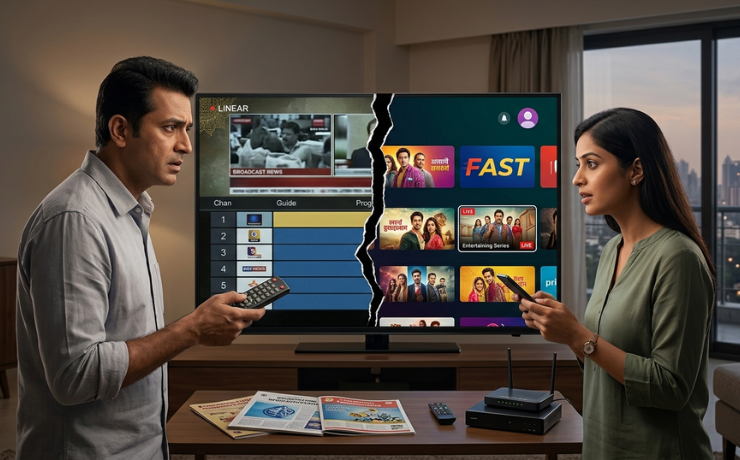
For years, the television business worked on a fairly simple understanding. Broadcasters created channels, distributors carried them, regulators oversaw the system, and audiences tuned in. Everyone knew where they stood in the value chain. But connected TV and streaming have quietly dismantled that clarity. The current TRAI consultation around FAST channels and ALTD platforms may sound like another regulatory exercise filled with technical terminology, but inside the media industry, it is being viewed very differently. This is no longer just a conversation about licensing frameworks or compliance structures. It has become a much larger debate about what television actually means in the internet era. Two of India’s biggest broadcast networks are now pushing sharply different visions of that future. One believes FAST channels are simply internet applications operating over open networks and should stay outside telecom and broadcasting regulation entirely. The other argues that if viewers experience these services like television — scheduled, linear and channel-based — then they should be treated like television regardless of how they are delivered. Somewhere between those two positions lies the real tension. Because FAST doesn’t behave entirely like television, nor does it behave entirely like OTT. It sits awkwardly in the middle, borrowing characteristics from both worlds while fitting neatly into neither. And that is exactly why the industry suddenly finds itself at an inflection point.
The first argument, the one pushing back against regulation, is rooted in how these services are technically built. FAST channels run through software layers, cloud infrastructure and internet delivery systems. Unlike traditional television, many of them have no dependency on satellite distribution or licensed carriage networks. In practical terms, they function more like apps than broadcasters. That distinction matters because the industry fears what happens if regulators decide that internet-delivered services should fall under telecom-style authorisation simply because they resemble TV channels on the surface. Today it may apply to FAST. Tomorrow the same principle could extend into OTT video, creator platforms or other digital media businesses that operate entirely online. That possibility is what makes broadcasters and technology players nervous. The concern is less about immediate regulation and more about the precedent it creates. Media businesses have spent the last decade moving toward flexible, cloud-led distribution systems because audiences themselves shifted there first. Trying to force those services back into legacy regulatory categories could create confusion not just for broadcasters, but for the wider digital ecosystem. One senior executive recently described the situation rather accurately: “The industry is trying to regulate a software problem using infrastructure-era thinking.” That line captures the discomfort many companies feel right now. The frameworks being discussed were designed for spectrum allocation, carriage permissions and physical distribution systems — not for internet-native media products that can be launched, modified and distributed globally through software updates.
At the same time, the broadcasters arguing for stronger oversight are not entirely wrong either. Their concerns are coming from market realities rather than technical definitions. From a viewer’s perspective, many FAST channels already look and feel like traditional television. They are linear, programmed and consumed in a lean-back viewing environment, especially on connected TVs. Some are simply repurposed TV feeds running through streaming infrastructure. Advertising on these platforms is increasingly being sold in ways that resemble traditional TV inventory as well. So broadcasters operating under programme codes, ad regulations and tariff rules naturally question why competing services delivering similar viewing experiences should function without equivalent obligations. But beyond regulation, the larger issue here is control over visibility. The real gatekeepers in connected TV are no longer cable operators or DTH platforms. They are smart TV operating systems, home-screen recommendations, pre-installed apps and algorithm-driven content rows. Those layers increasingly determine what audiences discover first. And unlike older distribution ecosystems, these decisions are often invisible to consumers. Broadcasters worry that while they continue carrying regulatory costs, newer ALTD players can scale rapidly inside software-controlled ecosystems without the same burden. That creates what many in the industry see as a structural imbalance. In older television markets, placement negotiations happened through carriage deals. In the connected TV world, discoverability itself has become the new carriage fee. Whoever controls the interface controls attention. And attention, more than distribution now, is what drives advertising economics.
What makes this debate particularly complicated is that both sides are arguing from valid positions. FAST channels genuinely blur the lines between broadcasting and digital media. They look like TV, distribute like OTT and monetise somewhere in between. That hybrid identity is why the consultation has become so difficult to resolve cleanly. A heavy telecom-style framework could slow innovation and discourage internet-native media businesses from experimenting in the space. But a completely hands-off approach could also create uneven rules between legacy broadcasters and newer streaming-led competitors. The industry is essentially confronting a question it has avoided for years: should television be defined by how it is delivered, or by how audiences experience it? That distinction becomes increasingly important as connected TV adoption grows in India. Consumers no longer think in terms of satellite feeds, cable boxes or internet protocols. They simply switch on a screen and expect content to appear instantly. Regulation, however, still depends on categories and definitions. That is where the challenge lies for policymakers. If linear viewing alone becomes the benchmark, large parts of the internet could eventually drift toward broadcast regulation. If infrastructure remains the defining factor, traditional television rules may steadily lose relevance in a streaming-first world. The answer probably sits somewhere between those extremes. What the industry likely needs is a lighter content-focused framework rather than a full telecom-style licensing structure. Basic programme standards, advertising transparency and audience safeguards can exist without forcing internet-layer services into outdated regulatory systems. At the same time, the connected TV discovery ecosystem deserves far more attention than it currently receives. Because that is where market power is quietly consolidating. The bigger story here is not whether FAST channels should exist inside broadcasting rules. It is whether India’s regulatory system is ready to accept that television itself is changing faster than the frameworks designed to govern it.

Disclaimer: Information mentioned here has not been verified or endorsed by Agency Reporter and is in accordance with the press release shared by the company or their appointed representatives
