










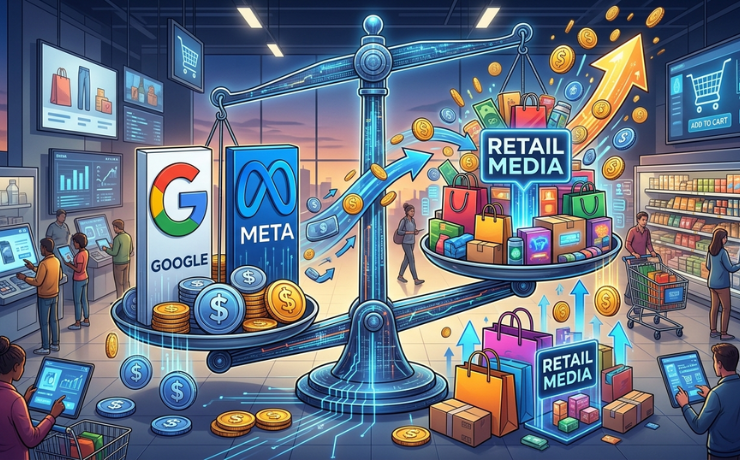
For years, media plans in India—and most of the world—have followed a familiar rhythm. Search for intent. Social for scale. Everything else filled the gaps. Google and Meta didn’t just dominate digital; they defined how marketers thought about it. But if you listen closely to how brand conversations are evolving today, there’s a noticeable shift in tone. The certainty that once came with those platforms is giving way to a more pragmatic question: what is actually driving business outcomes right now? And increasingly, the answer is pointing toward retail media.
This isn’t happening with the kind of noise that usually accompanies industry change. There’s no dramatic pivot or sudden exodus of budgets. Instead, it’s been a steady reallocation—line by line, campaign by campaign. What began as a tactical layer within e-commerce—sponsored listings, search boosts, in-app banners—has quietly become one of the most accountable environments for advertising. The logic is hard to argue with. When your ad sits next to a product, and that product can be purchased in the same moment, the distance between marketing and sales collapses. There’s less interpretation, fewer assumptions, and significantly less patience required from stakeholders asking, “What did we get for this spend?”
That immediacy is what makes retail media feel different. Google can tell you what someone is searching for. Meta can show you what they might be interested in. But retail platforms know what people are actually buying—and often, what they considered buying but didn’t. It’s a subtle distinction, but in practice, it changes everything. Instead of building campaigns around signals and probabilities, marketers are working with behaviour that has already translated into revenue. In a market where scrutiny on marketing spends has only intensified, that kind of clarity carries weight.
At the same time, the broader digital ecosystem is making this shift almost inevitable. Privacy changes, signal loss, and the slow fading of third-party tracking have complicated targeting and measurement across the open web. Even the most advanced platforms are still recalibrating. Retail media, on the other hand, operates within closed ecosystems where users are logged in, transactions are recorded, and data is continuously refreshed. It’s not immune to change, but it is structurally more stable. For brands trying to navigate an increasingly uncertain measurement landscape, that stability is becoming a deciding factor.
What’s perhaps more interesting is how retail media is evolving beyond its original role. It’s no longer confined to the bottom of the funnel. Retailers are building out their own media networks, offering display inventory, video formats, and even off-platform extensions that allow brands to target audiences beyond the marketplace itself. In effect, they’re starting to look less like commerce platforms with ad space, and more like full-fledged media owners powered by commerce data. And that opens up a new possibility: campaigns that don’t just convert demand, but also create it—within the same ecosystem, using the same data spine.
For agencies, this is where things get complicated. The neat separation between brand and performance, once a useful way to structure teams and budgets, doesn’t quite hold up in a retail media world. A sponsored product ad can influence discovery. A banner on a grocery app can reinforce brand recall. A video within a marketplace can shape consideration. The funnel is still there, but it’s less linear, more compressed. As one planner recently put it, “It’s like the checkout aisle has stretched all the way back to the entrance.” The implication is clear: planning frameworks need to catch up with how consumers actually move today.
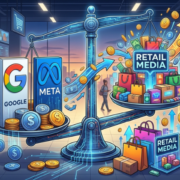
This doesn’t mean Google and Meta are losing relevance overnight. Far from it. Search remains unmatched in capturing high-intent demand, and social continues to shape culture and discovery at scale. But the way budgets are being distributed is changing. Where once these platforms absorbed the majority share by default, they are now part of a more contested mix. Retail media is no longer an afterthought; it’s a line item that demands serious consideration, often backed by results that are easier to defend in a boardroom.
In response, both Google and Meta are leaning harder into commerce. Shoppable formats, retail partnerships, and tighter integrations with product catalogues are all part of the play. They understand the direction the market is moving in. But there’s a structural difference they can’t fully bridge: they facilitate transactions, while retail platforms own them. That ownership gives retail media a certain credibility when it comes to measurement—a directness that is difficult to replicate.
For marketers, the takeaway isn’t to replace one channel with another, but to rethink how value is assigned across the mix. Reach still matters. So does storytelling. But increasingly, those need to be balanced with environments that can demonstrate clear, attributable impact. Retail media offers that, not as a silver bullet, but as a compelling complement—one that is steadily claiming a larger share of attention and investment.
If the last decade of digital was about capturing attention wherever it existed, the next phase seems to be about converting that attention as close to the point of purchase as possible. Retail media sits right at that intersection. And while it may not dethrone the incumbents entirely, it is reshaping the rules they’ve long operated by.
In the end, this isn’t just about budgets shifting from one platform to another. It’s about a deeper recalibration of what marketers expect from media itself. Less abstraction. More accountability. Fewer leaps of faith. As the industry adjusts, one thing feels certain: the closer media gets to commerce, the harder it becomes to ignore.
