







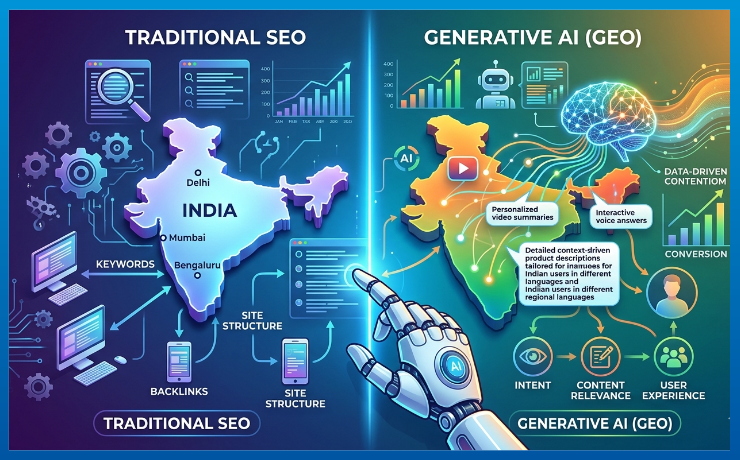
Ask yourself something honest. When was the last time you typed a query into Google and actually scrolled past the first three results? Now ask yourself something more telling — when was the last time you asked ChatGPT, Perplexity, or Google’s Gemini a question instead, read the answer it gave you, and never once clicked a link? If your answer to the second question is “more often than I’d like to admit,” then you already understand, instinctively, what the entire marketing and advertising industry is now scrambling to put into frameworks and strategies. The way people search is changing. Not incrementally. Fundamentally. And for Indian brands, agencies, and CMOs who have spent years perfecting their SEO playbook, the ground beneath them has quietly shifted while they were busy chasing rankings.
For two decades, Search Engine Optimisation was the backbone of digital visibility. You researched keywords, earned backlinks, optimised meta titles, and prayed to the Google algorithm gods. Every brand worth its salt had an SEO roadmap. The metrics were clear — impressions, clicks, rankings, traffic. It was a game with known rules. But something has changed at the consumer end of the equation that no dashboard is quite capturing yet. AI-powered platforms are now answering questions directly, synthesising information from dozens of sources into a single, confident, conversational response. The user reads the answer, absorbs the brand name or data point mentioned within it, and moves on — without ever visiting your website. This is not a niche behaviour anymore. McKinsey data from late 2025 points out that half of all consumers globally are already using AI-powered search intentionally as their primary way to find information and make buying decisions. In India, with over 700 million smartphone users, multilingual audiences, and one of the world’s fastest-growing AI adoption curves, this shift is not a distant future. It is the present.
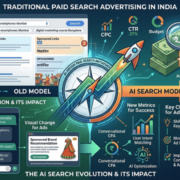
This is precisely where Generative Engine Optimisation — GEO — enters the conversation, and why every agency, brand manager, and digital strategist in India needs to treat it as an urgent priority rather than a next-quarter exploration. GEO, simply put, is the practice of optimising your content so that AI-powered search systems — ChatGPT, Google Gemini, Perplexity, Microsoft Copilot — can understand, extract, and cite it when generating answers. Unlike traditional SEO, where the goal was to earn a click, GEO’s goal is to earn a mention inside the answer itself. The distinction is not semantic. It is strategic. Research has found that fewer than 10% of the sources cited by major LLMs in their responses actually rank in the top 10 Google organic results for the same query. In other words, the SEO playbook that got your brand to page one does not automatically get your brand into the AI’s answer. You are essentially starting from scratch on a new visibility frontier. As one framing from the industry puts it plainly — SEO gets you found. GEO gets you trusted enough to be the answer. That is the shift Indian brands must internalise right now.
What does this mean practically for the Indian advertising and marketing ecosystem? For a start, it means the content conversation needs to change in every agency brief, every content strategy meeting, and every performance review. Content that is structured for GEO — clear headings, direct answers, cited data, expert authorship, E-E-A-T signals — tends to be content that AI systems find, parse, and reference. It also, not coincidentally, tends to perform better in traditional SEO because it aligns with what Google’s own helpful content guidelines reward. The two disciplines are not enemies; GEO is an additional layer on top of SEO, not a replacement. Indian brands that already have strong topical authority and domain credibility — the ones that have done the SEO work honestly — are actually well-positioned to win in GEO, provided they now optimise for AI retrieval rather than just search rankings. The early movers in this space are already seeing results. One Indian NBFC that restructured its content using structured FAQs and AI-readability frameworks saw its brand citations in Gemini’s answer clusters grow by 40% within three months. The opportunity is real, and in a market where most SMB marketing teams have not yet begun a GEO initiative, first-mover advantage is still on the table. For Indian agencies specifically, there is a compelling commercial opportunity here — clients are going to need guidance, audits, strategy, and measurement frameworks for AI visibility. The agencies that build that capability today will own a new category of retainer by end of 2026.
None of this means burning your SEO budget or abandoning what has worked. The smartest brands will treat 2026 as the year they built both disciplines in parallel — strengthening their SEO foundation while simultaneously developing the content authority, earned media presence, and structured data architecture that GEO demands. The shift is not about chasing another acronym. It is about understanding that your customer has changed how they look for answers, and your brand’s visibility strategy must follow them there. Because if someone asks an AI about your category, your competitor’s sector, your brand’s reputation, or your product’s strengths — and your brand is simply not part of that answer — you are invisible to a customer who may never even know you existed. In the Indian market, where consumer trust is hard-won and brand recall is everything, that is a risk no advertiser can afford to take sitting down.
