












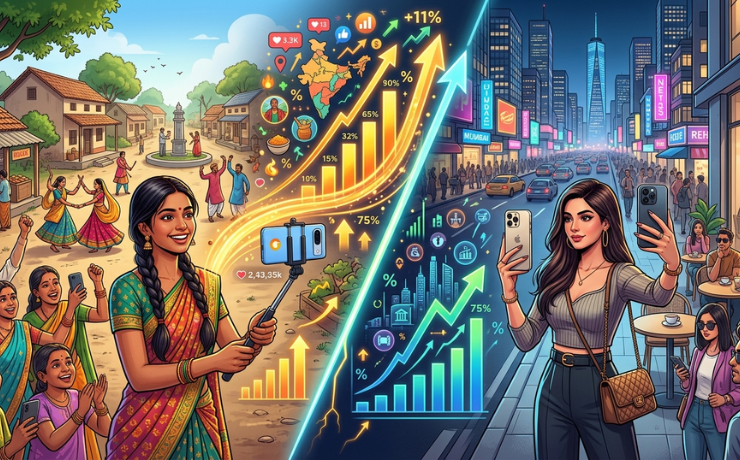
For years, influencer marketing in India has followed a familiar playbook. Brands gravitated toward metro-based creators—those with polished feeds, English-first content, and large, visible followings concentrated in cities like Mumbai, Delhi, and Bengaluru. It made sense on paper. These creators offered scale, aspirational value, and alignment with urban consumer segments that brands traditionally prioritised. But beneath that surface, a quieter shift has been underway. As India’s internet base expands deeper into Tier 2 and Tier 3 markets, the dynamics of influence are changing—and the data is beginning to reflect it. Regional creators, once considered niche or supplementary, are now delivering stronger engagement, deeper trust, and, increasingly, better business outcomes than many of their metro counterparts.
The numbers tell a compelling story. Across multiple campaigns, regional influencers are consistently outperforming metro creators on key metrics that matter—engagement rates, click-throughs, and conversions. Some studies indicate that regional creators can drive significantly higher engagement, often because their audiences are more tightly knit and less saturated with branded content. In practical terms, this means their followers are more likely to notice, interact with, and act on what they share. Conversion rates, too, tend to be stronger. When a regional creator recommends a product—especially in categories like FMCG, beauty, or consumer durables—it often carries the weight of familiarity and trust, rather than just visibility. One marketer summed it up neatly: “Metro creators can amplify a message, but regional creators can make it believable.” That distinction is becoming increasingly important in a landscape where attention is abundant, but trust is scarce.
The reasons behind this outperformance are less about algorithms and more about human behaviour. Regional creators operate within cultural and linguistic ecosystems that feel inherently more relatable to their audiences. They speak in local languages, reference shared experiences, and reflect everyday realities that large, metro-centric content often overlooks. This creates a sense of authenticity that is difficult to manufacture. Their content doesn’t feel like it’s designed for a broad, undefined audience—it feels like it’s meant for you. In many ways, their influence mirrors traditional word-of-mouth, scaled through digital platforms. When a creator from a Tier 2 city talks about a product, it doesn’t come across as a distant endorsement; it feels like a recommendation from someone within the community. That proximity—cultural, linguistic, and social—is what drives stronger engagement and, ultimately, action.
There’s also a structural shift in India’s digital landscape that’s accelerating this trend. The next wave of internet users is not coming from metros—it’s coming from smaller towns and cities, where regional languages dominate content consumption. As a result, the centre of gravity for digital attention is moving beyond English-first platforms and creators. Brands that continue to prioritise metro influencers alone risk missing out on where actual growth is happening. More importantly, they risk misaligning with how new audiences discover and trust products. In these markets, influence is less about aspirational lifestyles and more about relevance. A creator who reflects local realities—price sensitivity, usage habits, cultural nuances—will often have more impact than one who simply represents a polished, urban ideal.
This isn’t to suggest that metro influencers are becoming irrelevant. They continue to play a critical role, particularly in building top-of-mind awareness, shaping brand perception, and driving cultural conversations at scale. But the balance is shifting. Where metro creators once dominated both reach and impact, their role is increasingly being complemented—and in some cases challenged—by regional voices that deliver stronger performance deeper in the funnel. For brands, this calls for a more nuanced approach to influencer strategy. It’s no longer about choosing between metro and regional; it’s about understanding what each brings to the table and structuring campaigns accordingly.
The implications for marketers are significant. First, measurement frameworks need to evolve. Follower count and vanity metrics are no longer sufficient indicators of influence. Engagement quality, audience relevance, and conversion impact are becoming more important—and regional creators often score higher on these dimensions. Second, content strategy needs to adapt. Working with regional creators isn’t just about translating scripts into different languages; it’s about co-creating content that feels native to the creator’s voice and audience. That requires giving up a degree of control and trusting creators to interpret the brand in ways that resonate locally. Third, media planning needs to reflect this shift. Budgets that were once concentrated on a handful of large influencers are now being distributed across a wider, more diverse creator base—often with better returns.
There’s also a mindset shift required at the brand level. For a long time, there has been an implicit bias toward metro-centric content—an assumption that it is more “premium,” more “aspirational,” and therefore more valuable. But as consumption patterns evolve, that assumption is being challenged. Premium is no longer defined solely by production quality or urban context; it’s increasingly defined by relevance and resonance. A well-shot video in English may look polished, but a relatable, vernacular piece of content may drive far more meaningful engagement.
Looking ahead, the rise of regional creators is unlikely to be a temporary trend. It reflects deeper changes in how India consumes content, how communities form online, and how trust is built in a digital environment. As platforms continue to invest in vernacular ecosystems and as brands become more comfortable working with diverse creator pools, the gap between metro and regional influence will only become more pronounced.
In the end, this isn’t just about geography—it’s about understanding where influence truly lives. For years, brands have equated scale with impact, assuming that bigger audiences automatically translate to better outcomes. Regional creators are challenging that assumption. They may not always have the largest followings, but they often have the most meaningful ones. And in today’s marketing landscape, that distinction can make all the difference.
