





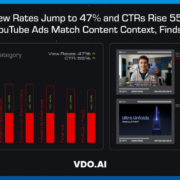






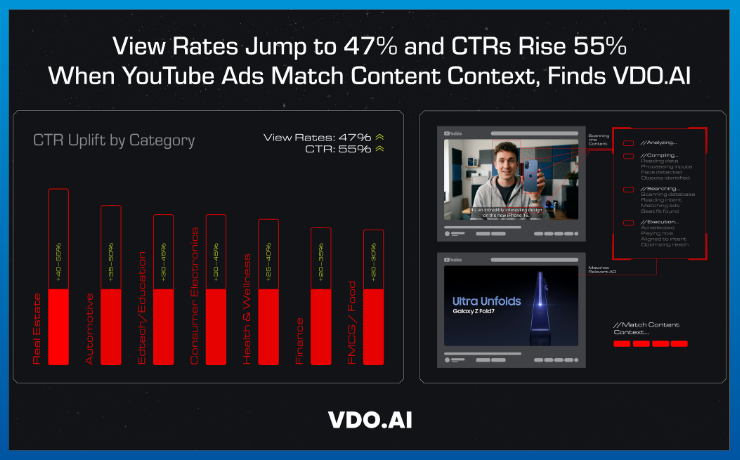
Contextual targeting on YouTube is delivering CTR uplifts of up to 55% and pushing view rates from 31.9% to as high as 47%, according to VDO.AI’s YouTube Advertising Trends Report. For most brands advertising on YouTube, audience targeting has historically been the primary lever, followed by demographics and intent signals. What has received far less attention is the content environment itself.
Drawing on campaign data across seven verticals, the report finds that the content environment is consistently the variable that separates high-performing campaigns from average ones. Alongside the CTR and view rate gains, brand suitability improves from around 70% to over 95%, suggesting that contextual alignment lifts performance and safety in equal measure.
Across verticals, the data points to a consistent pattern. Real estate brands running ads alongside home tours and interior content see CTR uplifts of 40-55%, the highest in the report, followed by automotive advertisers aligned with car reviews and test drives at 35-50% and consumer electronics brands appearing next to tech reviews and unboxing content at 30-45%. The pattern holds across FMCG, Health and Wellness, Finance and EdTech, where uplifts range from 20-45% depending on the category and content alignment. At the transaction level, retail CTRs move from 0.84% to 1.2-1.8% and travel campaigns from 0.78% to 1.1-1.6%.
Arjit Sachdeva, Co-founder, VDO.AI, said, “There is a growing body of evidence and our report adds to it, that audience targeting alone does not fully explain YouTube campaign performance. Across the seven verticals we analysed, campaigns aligned to relevant content environments consistently outperformed unaligned ones on every measured metric. For the industry, the lesson is that context is not a refinement of audience targeting. It is a parallel input that deserves equal rigour at the planning stage.”
What the data ultimately points to is a fairly simple but consequential shift in how YouTube advertising is being evaluated. The industry has long asked who is being reached. The evidence from VDO.AI’s trends report suggests the more determining question is what that person was watching when the ad appeared. As YouTube continues to scale across screens and formats, the content environment is emerging not as a refinement of existing targeting practice but as a variable in its own right.

Read also: What ChatGPT and AI search mean for paid search advertising in India
Disclaimer: Information mentioned here has not been verified or endorsed by Agency Reporter and is in accordance with the press release shared by the company or their appointed representatives
