





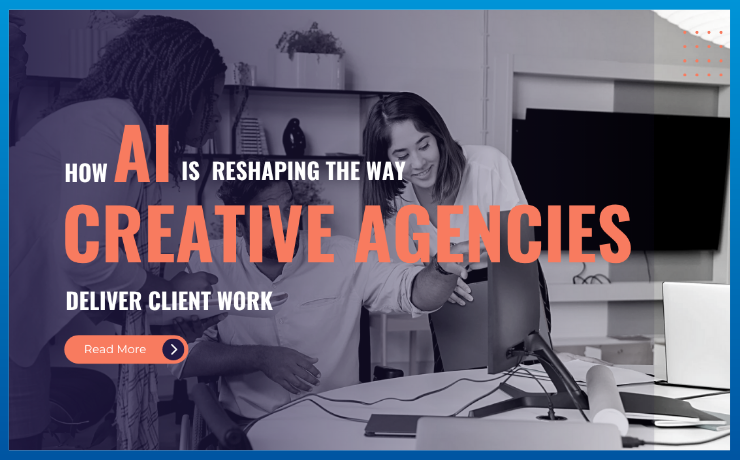
Working in social media inside an agency often feels like being at the centre of a moving storm—deadlines tightening, platforms evolving, audiences demanding more personalised content, and brands expecting faster turnarounds without compromising on creativity. For years, we solved this through longer hours, tighter processes, and bigger teams. But over the last 18–24 months, a new force has quietly rearranged the way we operate: generative AI. And unlike most trends that come and go, this one is not a passing wave—it’s a structural shift in how agencies think, create, and deliver work.
I’ve seen AI move from being a “nice-to-have exploration project” to an integral part of everyday operations. Not because it is replacing people, but because it is taking away the heavy, repetitive, mind-numbing parts of the job that used to consume a huge portion of our day. What used to take a week can now take a day and What required a team of five may now only need two people who know how to harness AI well. And what once felt like a chaotic juggling act has slowly turned into a more streamlined, more deliberate, and arguably more creative workflow.
Brainstorming and Ideation: No Longer a Blank Page Battle
If there is one stage of agency life where AI’s impact is instantly visible, it’s the early ideation phase. Before AI tools became part of our routine, brainstorming involved multiple meetings, sticky notes everywhere, creative blocks, and the pressure of coming up with something “fresh” under constant time constraints. Every social media executive knows the dread of staring at a blank content calendar or searching for new angles for a brand that has been posting for years.
Generative AI has removed that fear of starting. Today, the first few hours of any planning cycle begin with feeding prompts into our AI tools—not to get a finished answer, but to spark thinking. The tool throws out several possible directions, tones, and formats, and often one unexpected line or angle becomes the seed that the team builds on. Instead of losing a day to warm-up, we enter the creative phase already stretched across five or six possible territories.
This doesn’t make ideation mechanical. In fact, it makes it more human. The grunt work is taken care of, allowing us to spend more time refining ideas, aligning them with brand thinking, and shaping narratives that can actually travel across social platforms. AI widens the playground; the craft and judgment still remain very human.
Copy, Captions, and Content Buckets: The New Pace of Delivery
Copywriting is another space where the shift has been remarkable. Earlier, writing twenty caption variations for A/B testing or developing long lists of headline options could take hours. Today, AI can generate a wide range of first drafts within minutes. The trick lies not in letting it write for you, but in letting it write with you.
The biggest benefit is the time saved on early-stage writing and rewriting. AI can draft the structure, tone, or rhythm of a piece, and then we refine it with the nuance, brand emotion, and contextual sensitivity that only a human writer brings. Instead of wrestling with phrasing for half a day, we now spend our time polishing, shaping, and elevating the message. It is still writing—it’s just faster, more efficient, and less exhausting.
Planning has also become smoother. With generative AI, we can quickly generate monthly content buckets, explore creative combinations, and ensure that our calendars don’t fall into the trap of repetition. It helps maintain freshness even for long-term retainers, something that used to be a real struggle.
Visual Creation: From Hours to Minutes
The design and visual creation process has probably undergone the most dramatic shift. Earlier, even creating a simple reference deck for a campaign could take hours of browsing, collecting, and stitching inspiration. Now, we can generate mood boards, sample visual styles, layout options, and color palette trials in a fraction of the time.
This does not replace designers. What it does is give them clarity and speed. They no longer start from a blank canvas—they start from a guided visual direction that the team has aligned on. AI-generated drafts help eliminate miscommunication, reduce back-and-forth, and allow designers to spend more time on actual craft and polish. And most importantly, it allows agencies to create personalised, multi-format visuals for different platforms without ballooning timelines or budgets.
For brands that demand hyper-personalisation—regional content, audience-specific messaging, festival-based variations—AI has made it viable in a way that manual processes never could.
Execution, Optimisation, and Reporting: The Invisible Upgrade
There is another part of agency workflow that people outside don’t often talk about: the operational backbone. Scheduling posts, tagging campaigns, pulling weekly numbers, running performance reports, analysing what worked and what didn’t—it’s the part of the job that keeps things running, but often drains energy.
Generative AI and AI-powered automation tools have transformed this back-end drastically. Many agencies now use AI to analyse performance data, summarise insights, recommend content tweaks, and even generate early performance reports. It’s not perfect, and it still needs human validation, but it saves hours every week.
A/B testing, too, has become quicker. AI can create copy or visual variants instantly, allowing teams to test more combinations and optimise campaigns more intelligently. Instead of spending time creating variations, we can spend time reading patterns, interpreting audience behaviour, and making strategy calls.
This is the part of AI that often doesn’t get the spotlight but has the most profound impact on how social teams manage time and energy.
Where This Leaves Us as Humans in the Loop
With all these shifts, one question often comes up: Does AI replace creativity?
From what I’ve experienced, the answer is a clear no.
AI has removed the layers of repetitive, manual, operational tasks that used to consume the majority of our workday. What it leaves behind is the part that really requires human judgment—brand understanding, storytelling, emotional intelligence, cultural nuance, and strategy.
Instead of replacing creativity, AI has given us more space to be creative.
Instead of shrinking roles, it has deepened them.
Instead of making work robotic, it has made it more thoughtful.
As someone who works on the front lines of daily content creation, I can say this confidently: generative AI isn’t taking jobs away. It’s taking the drudgery away. And in the agency world, that is a welcome evolution.
