













AI Content Moderation in Indian Advertising: Brand Safety in a Multilingual Market

As programmatic and CTV spending pours into India’s regional-language content, brand safety tools built for English are missing the things that matter most — and the gap is becoming an advertiser’s problem.
A skincare brand’s ad appears mid-roll on a Bhojpuri YouTube channel, sitting comfortably beside a video flagged for misogynistic commentary that no automated filter caught. A fintech company’s banner runs on a Tamil news aggregator next to a story containing communally charged language — language that an English-trained classifier read as neutral, because it had never seen those words before. Neither incident makes headlines. Both happen, in some form, every day across India’s digital advertising ecosystem. And both point to the same uncomfortable truth: the brand safety infrastructure most Indian advertisers rely on was never built for the market it now operates in.
A Market That Outgrew Its Tools
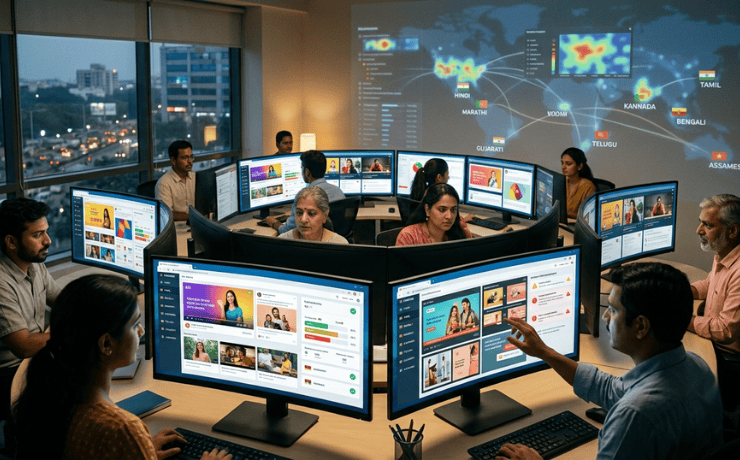
India’s digital ad spend has moved decisively toward video, connected TV, and regional-language platforms over the past few years, and vernacular content has been the biggest driver of that growth. Hindi, Tamil, Telugu, Bengali, Marathi, and a long tail of other languages now account for a large and growing share of time spent on video and social platforms, particularly outside the metros. Brands chasing this audience are, by definition, placing their ads against content that most global brand safety systems were not designed to read.
This is not a small technical footnote. Brand safety and suitability tools are the layer that decides, in real time, whether an ad runs next to a piece of content or gets blocked. When that layer can reliably parse English news articles but struggles with a Telugu comment thread or a Hinglish Instagram reel, the result is not a modest accuracy gap — it is an entire category of content operating with significantly less oversight than the rest.
The English-First Blind Spot
Most contextual AI and brand safety classifiers in wide commercial use were trained primarily on English-language data, with other major world languages added in varying degrees of depth. Indian languages, particularly when written in non-native scripts, sit even further down that list. A huge volume of Indian social content is written in Roman script rather than Devanagari, Tamil, or Bengali script — Hindi typed as “kya bakwaas hai” rather than in Devanagari — and this transliterated, code-mixed text is precisely where many moderation models perform worst.
Hinglish is not an edge case in India; for large parts of the digitally active population, it is the default register for casual writing. A classifier that has not been meaningfully trained on this register will either over-flag harmless conversational content as risky, or — more dangerously for brand safety — fail to flag genuinely harmful content because it simply doesn’t recognise the words being used.
“Most brand safety dashboards still report on India as if it were a single English-speaking market with some ‘regional’ content layered on top. In reality, the regional content is the market.” — A Bengaluru-based programmatic trading lead at a media agency
Where Nuance Breaks the Model
Even when a moderation system can technically process an Indian language, it often struggles with the layers of meaning that make content risky in context rather than in isolation. Political commentary, religious references, caste-related language, and regional rivalries carry weight in India that a literal translation does not capture. A phrase that reads as neutral in a word-for-word translation can carry an entirely different charge depending on the community, region, or platform where it appears.
Sarcasm and humour compound the problem. Indian social media, much like social media everywhere, runs on irony, memes, and in-jokes that shift meaning week to week. A model trained even a year ago on what counted as inflammatory language may already be behind the current vocabulary — and in a market with twenty-two official languages and hundreds of dialects, “behind” rarely means behind in just one of them.
The Multimodal Problem: Audio and Video
Text-based moderation, for all its flaws, is still the easier half of the problem. CTV and OTT growth has shifted a meaningful share of ad inventory into long-form video and audio, where moderation depends on accurate transcription, translation, and tonal analysis across multiple languages — often within the same piece of content, as creators code-switch mid-sentence. Automated speech recognition for Indian languages has improved, but accuracy still varies widely by language, accent, and audio quality, and errors compound quickly: a mistranscribed word can change a classifier’s read on an entire segment.
For brands running pre-roll or mid-roll ads across regional OTT platforms, this means the contextual safety check happening behind the scenes may be operating on a transcript that is only partially accurate — and making placement decisions on that basis.
The Vendor Landscape Hasn’t Fully Caught Up
Global brand safety and verification vendors have expanded their language coverage over time, and most now offer some level of support for major Indian languages. But “support” and “parity with English-language accuracy” are not the same thing, and advertisers rarely get visibility into the difference. Few brand safety reports break down false-positive and false-negative rates by language, which means a brand running campaigns across Hindi, Tamil, and English inventory may be getting meaningfully different levels of protection across each — without ever seeing that reflected in a single blended safety score.
A smaller set of India-focused adtech and trust-and-safety companies have built tools specifically tuned to Indian languages and platforms, often with larger human moderation teams working alongside automated systems. These tend to be more accurate for vernacular content, but they are not yet the default choice for most media plans, which still route through global verification partners as a matter of procurement habit.
“We can tell a client exactly how their English campaign performed against brand safety benchmarks. For the Marathi or Kannada portion of the same campaign, the honest answer is often: we’re not entirely sure.” — A brand safety consultant working with Indian D2C advertisers
The Regulatory Layer Is Catching Up Too
Brand safety in India is no longer purely a reputational concern. The IT Rules and subsequent amendments have placed greater accountability on platforms for harmful content, and advertising self-regulation bodies have sharpened guidelines around misleading and harmful advertising. While these frameworks are aimed primarily at platforms and publishers rather than advertisers directly, the practical effect is that brands operating in this space are increasingly expected to demonstrate that they have taken reasonable steps to avoid harmful adjacencies — in every language they advertise in, not just English.
This raises the stakes for brand safety to move from a “nice to have” line item in a media plan to something closer to a compliance requirement, particularly for categories like finance, healthcare, and children’s products where regulatory scrutiny is already higher.
Why Human-in-the-Loop Still Matters
The most reliable brand safety setups for Indian regional content currently combine automated screening with human reviewers who are native or fluent speakers of the relevant language — and, crucially, familiar with the regional and cultural context that a model trained on aggregate data tends to miss. This is not a rejection of AI moderation; it’s a recognition that for a market this linguistically fragmented, AI is currently better used to triage at scale and flag edge cases for human review than to make final calls alone, especially in higher-risk categories.
For agencies, this opens a practical question worth raising with clients directly: does the brand safety setup on a given media plan actually reflect the language mix of the audience being targeted, or is it a one-size-fits-all configuration inherited from a global template?
The Opportunity for Agencies and Brands
For agencies willing to dig into this, language-aware brand safety auditing is becoming a genuine differentiator. That can mean something as straightforward as requesting language-level breakdowns from verification vendors during the RFP process, or as involved as building a layer of local-language review for high-spend regional campaigns. Either way, it signals to clients — particularly those in regulated categories — that brand safety has been considered as a multilingual problem rather than ported over from a global playbook.
There is also a longer-term opportunity in the vernacular NLP space itself. As more Indian-language datasets become available for training, the accuracy gap between English and regional-language moderation should narrow — but that narrowing will happen faster for languages with more digital content and slower for others, meaning the gap itself will become uneven rather than disappearing all at once. Brands and agencies that understand where the gaps currently sit will be better placed to manage risk in the meantime.
The Bottom Line
India’s advertising growth story is, increasingly, a regional-language story — and brand safety infrastructure needs to catch up to that reality rather than treat it as an afterthought. The tools are improving, the regulatory environment is tightening, and the cost of getting this wrong — both reputational and, increasingly, compliance-related — is rising. For now, the safest assumption for any brand running campaigns across India’s linguistic diversity is that the protection on offer is not uniform, and that asking pointed questions about language coverage is no longer optional.
